You're arrived at a friends house that you haven't seen in a while to pass some time. After 30 minutes of watching hilarious YouTube videos, you guys decide to move on to playing some video games. “That's fine,” you thought, because both of you are avid gamers.
After a couple minutes of back-and-forth indecision, your friend finally pulls out a copy of Super Street Fighter 4 for the PS3. “You don't mind if we play some rounds? Are you good at this?”
“Oh cool. Uh, yeah, I've played” you say somewhat optimistically.
However, this is a lie. You haven't played a Street Fighter game since Street Fighter II on the SNES. “Street Fighter was mad fun. I wonder if I can still do Rye-you's fireball. This shouldn't be any different, right?” as your naive, little mind reassures you as you put your hands on the PS3 Dualshock while your friend pulls out a huge, $150 arcade stick that looks bigger than the damn PS3 itself.
 To me, the fighting game world is perfect. Nothing to rearrange.
“Whatever. I guess I'll give you a quick tutorial. I already put in the game so might as well get this over with,” your friend says dejectedly.
As you play, you furiously start to mash buttons, thinking you're playing a side-scrolling beat-em-up like the X-Men Arcade game, as well as your thumb consistently doing the down-to-forward motion on the analog stick (the “Rye-you's fireball” motion that you happened to forget and were recently reminded). As you're doing this, your friend is only pushing one button – the Medium Kick button - and topples you with a perfect victory.
You sit there, puzzled. Thirty minutes and a 14 – 0 record later (6 of them being perfects), you tell your friend you don't feel like playing Street Fighter anymore. Several thoughts go through your head: Why isn't this the same fun as your childhood? Why couldn't you grasp the game as quick as playing a multiplayer shooter or action game? Why is every fiber of your being terrible?
“I thought you played this before? I was hoping you did. Not many of my friends play, so I was hoping for competition, but instead all I got was your scrubby @$$,” he says as he turns off the game, puts the arcade stick away, and puts on Gigli to pass the time.
Your friend is a dick. But it's not his fault. Not entirely, at least.
Fighting games are seemingly built from the ground up to steer casual players away from playing them for more than an hour. At first, the games seem simple enough: two people fight, one person lowers the other dude's life bar to empty (once, twice, maybe thrice), you do a cool victory pose, you tack on a win and another guy tries to beat you up. Rinse and repeat.
However, once you start observing the details further, there are those aspects of fighting games that frighten gamers to pacification.
First and foremost are the controls. A game like Halo is simple: Press a button/trigger to shoot, press a button to jump, move around with two analog sticks, shoot people, call yourself a gamer. Easy to understand, and applicable to a competitive level.
A game like Street Fighter, however, has basic movement like jumping and moving forward, but has SIX buttons for attacks (Light, Medium, Hard for Punches and Kicks). Each of those “normal moves” has a different function standing far away from the opponent, standing close to the opponent, jumping toward/away from the opponent, jumping in a neutral state, and crouching. And guess what? They differ from character to character. Your mental bucket was already full from the concept of six buttons being used in a game.
Not only are there various normal moves, but “special” moves are quite daunting for the casual player (i.e. Ryu's “Hadouken,” Chun-Li's “Lightning Legs,” Blanka's “Being Ugly as Hell”). A Quarter Circle Forward motion (QCF, where you press down, down-forward, then forward in a smooth motion) can take minutes to learn, while a Dragon Punch (or “DP” motion – forward, down, down-forward) can take dozens of minutes, or even an hour, or even never because, dammit, all you wanted to do is make Ken from Street Fighter do a cool flaming uppercut with the power of blonde anglo-saxon karate fighting in your palms.

The guy on the right (Geese Howard from Fatal Fury) is doing "Raging Storm," which is performed by inputting down-back, forward, down-forward, down, down-back, back, down-foward + two punches in one motion. kill me now
Mechanics of fighting games create a steep learning curve. For example, defense: not only do you have to attack, but you have to (gasp) DEFEND. Defense differs from game to game – some games require you to press a direction away from your opponent and some require you to press a button for Guard (a la Soul Calibur). Some attacks hit high, some attacks hit low; sometimes you can guard in the air, sometimes you can parry an attack. The only way to beat a guard outright, sometimes, is to throw. How do you beat a throw? You “tech” a throw by canceling it out with your own throw input. How do you beat a tech? Yomi.
Casual gamers also hear things about “framedata” from “pro” players, and that you have to “count frames during the game in order to be good.” This is heavily misconstrued. You have to count frames before you start playing the game, and if you don't memorize frame charts for all the characters moves, you basically have no chance at learning the game.
Just kidding! But seriously, you don't have to learn frame data to learn a fighting game. Frame data is completely referential, and while it's helpful to know that Balrog's jab has 3 startup frames, it's not absolutely necessary. The more you play fighting games, the more you know what moves beat which moves, what moves are fast or slow, and which moves are able to get you hate messages on PSN or XBL calling you a “spamming scrub” or telling you “u suk at this game, Chun Li is ovrpoweres dawg.”
The key is to keep playing, but there is such a pronounced skill gap between new and seasoned players that, generally, newer players get turned off by it. If a person sucks at Modern Warfare 2, he's able to at least get a few cheap kills from someone who wasn't looking and learn from there. However, fighting games aren't that rewarding. One must grind, loss after depressing loss against someone that's good, in order to learn the game. They eventually have to ask a good player what their own flaws are, and work on those in order to succeed. They have to put effort in a game, which by all means is very undesirable for the casual crowd.
The fighting game community doesn't really help the casual presence. They like to see new blood, of course, but it's a steep road to be competitive in fighting games. Game mechanics in newer fighting games, such as in Street Fighter 4, have been shunned by fighting game enthusiasts because they appeal to casual gamers (such as lenient special move motions, “Ultra” combos with low risk/high reward, etc).
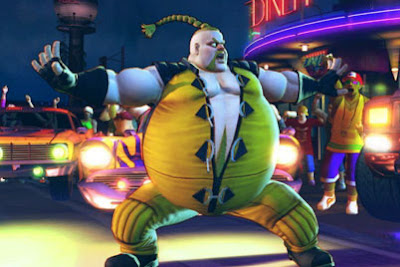 This guy (Rufus) is considered one of the top (if not the top) tiered characters in Super Street Fighter 4 because of his easy damage combos and easy Ultra combo setups. But mostly because he's fat as hell and so is the USA (he's American)!!!!
Nostalgia (like for Super Street Fighter 4) can create initial burst in sales but can't create a large a group of new, lasting players like the FPS genre or even RTS genre can. There will always be a huge divide between causal and seasoned fighting game players, much bigger than any genre out there. If you want a fighting game with a much smaller gap of skill, there's always Super Smash Bros Brawl, right?
(By the way, the “friend” at the beginning of the article was me. The Gigli thing wasn't a joke.)


