Like the typical, hardcore, Wii gamer, I bought the Motion Plus add-on as soon as it came out. It was only $20, and I was sure there would be many more games coming out that will need the 1:1 apparatus of motion control. Or, at the very least I thought, the next Zelda will have Motion Plus. Well, turns out that the very least is exactly what I got. That's not a remark on Red Steel 2, but on the countless companies that failed to utilize the accessory. Ok, countless may be stretching it. It has, after all, only been on the market since June 2009 and any game that was in the works before that couldn't possibly add such a unique feature as an afterthought. Red Steel 2, however, implemented it beforehand with ample time, despite the game's lack of commercial success. In regards to the poor sales figures, the Creative Director, Jason Vandenbergite, of the game told IGN that Red Steel 2 had a very small audience window and explained how gamers didn't want to "exert themselves." Neither of those arguments is unfair, but the latter makes me wonder about the future of the Playstation Move and Microsoft's Kinect.
To begin with Red Steel 2, I must admit I was excited to play this game long before I ever got the chance. Sword fighting, westerns and 1:1 movement will do that to me. But my first copy of the game had to be sent back because it was faulty and it was over a month before I found it again for the same price. So one can understand that the buildup of desire was much like that of a virgin high schooler at his prom. I was also just as hopeful of experiencing something that I thought would change everything. I would never -- could never -- go back to what it was like before direct 1:1 motion. For those of you not familiar with the Motion Plus accessory, it doesn't live up to this hype, which is seen clearly now with the noticeably few games that even offer the option of using it. Only one game, to date, takes advantage of the accessory and offers a complete gaming experience. The review of Red Steel 2, then, must include a review of Motion Plus gaming.
The opening cinematic of Red Steel 2 was very impressive. You begin by being tied by the wrists to the back of a motorcycle going through the desert and nearby city. I instantly thought, "wow, this looks fantastic. Cel-shading and the Wii are a perfect match." Even better was the idea that whoever gets dragged behind a bike like that would surely be dead by the end of the ride. I even winced a couple times when hitting glass bottles. Eventually the sequence ends and I was happily surprised when the in-game graphics stayed in step with the cinematic. We find out our hero is a member of the Kusagari clan, and so we start wandering the city in search of other Kusagari clansmen. At first the only weapon available is a gun, but that changes after a few minutes. The moment of truth for the Motion Plus add on. Can 1:1 movement improve the overall quality of a game? It took some getting used to, that's for sure. At first I was not able to swing the sword without turning the point of view in tandem with my swing. But, yes, there was 1:1 movement and it definitely made a difference in the game. For instance, the game immediately tells you to swing "with your elbow" because frilly wrist waggles won't be enough. The strength of the sword swipe depends on how fast and long your movement is. I can honestly say that my arm felt a little sore after a while, though, and I used to play tennis.
The entire set up works very well together. Motion Plus completely changes the action of the game. Since no one without wrists the size of dictionaries will be able to make little movements effective against the enemies, the gameplay is much more difficult. No sitting and leaning back. You gotta be front and center, ready to have broad slashes against armored foes. It doesn't feel like you're actually swinging a sword, even if the Wii remote is now longer, but it does get your head more into the game. As for the gun, there's nothing special there. It would work exactly the same without Motion Plus. Think Resident Evil 4 but without the stationary shooting. And the zombies.
As I mentioned earlier, the game's story is reminiscent of a spaghetti western. You get to play the wanderer who comes in to clean up the town, which is under siege by a group of bandits. In addition, there is also some classic Japanese story-telling here. The lone samurai, having been disgraced and banished by his clan, returns to help in a clan war and has to deal with other, sword-wielding assassins. The look and sound also blend the East and West. Not only are there paper lanterns, but telephones and vending machines. Not only is there a drunken-ish sheriff, but also a samurai master who reluctantly agrees to train you. If you're a fan of films like "Unforgiven" or "The Good, the Bad and the Ugly" you will recognize the classic western sound, but with a Japanese tinge to it.
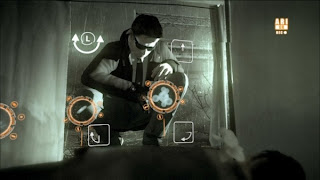
The combat gameplay largely relies on the sword, but that's the point. There is the option of buying additional guns and upgrades for them, but you can play the whole game without using your gun, while you need the sword for several things from taking off an enemy's armor to using for finishing moves. Also, almost everything you see lying around is breakable and will give you cash to purchase said upgrades; it would just be a waste of bullets to use them on shooting up every barrel and trash bag. The last little detail I would mention is the surprising use of the Wii remote speaker. Personally, mine is always off because the sound is usually awful quality and adds nothing to the experience. But, in Red Steel 2, the speaker is used to hear clicks when trying to unlock safes. You turn the remote as if it was the lock on the safe itself and listen for the clicking to know where to press A. Not a bad idea or implementation -- it was certainly never annoying. High praise for that little speaker.
To sum up this game, I can say it was a unique, enjoyable experience. The Motion Plus attachment was iffy at first, but over time I felt more and more comfortable with it. The point of view rotating with the swing stopped happening and really never happened in combat to begin with. The story was a nice mixture of classic plots, although the voice acting was a little off-putting, but there aren't many games that do that too well. I enjoyed the way to accept missions, along with collecting money, optional side quests, and upgrading your gun and sword. This game has a great deal of positives going for it and the addition of the, sadly under-used, Motion Plus does increase the overall quality. Especially in light of being one of the only games after a year to use it. I rate both Motion Plus and Red Steel 2 as Super Dope.
4.5/5 Near Perfect Score! Super Dope!